“When you’re homeless, you’re surviving – not thriving. You can’t think about the next day when you need to survive today.”
It’s something most of us take for granted, but for Tamika Bennett, Youth Advocate at the Youth Advocacy Centre (YAC), a roof over her head was never assured. She spoke powerfully of her experience at The Lady Musgrave Trust’s 17th Annual Forum on Women and Homelessness.
Tamika’s experience is not unique: in 2025, approximately 10,000 people in Queensland experience homelessness – and some reports put the figure as high as 22,000. The rate of homelessness in Queensland is already 22% above the national average – and the picture is grim for young people and families.
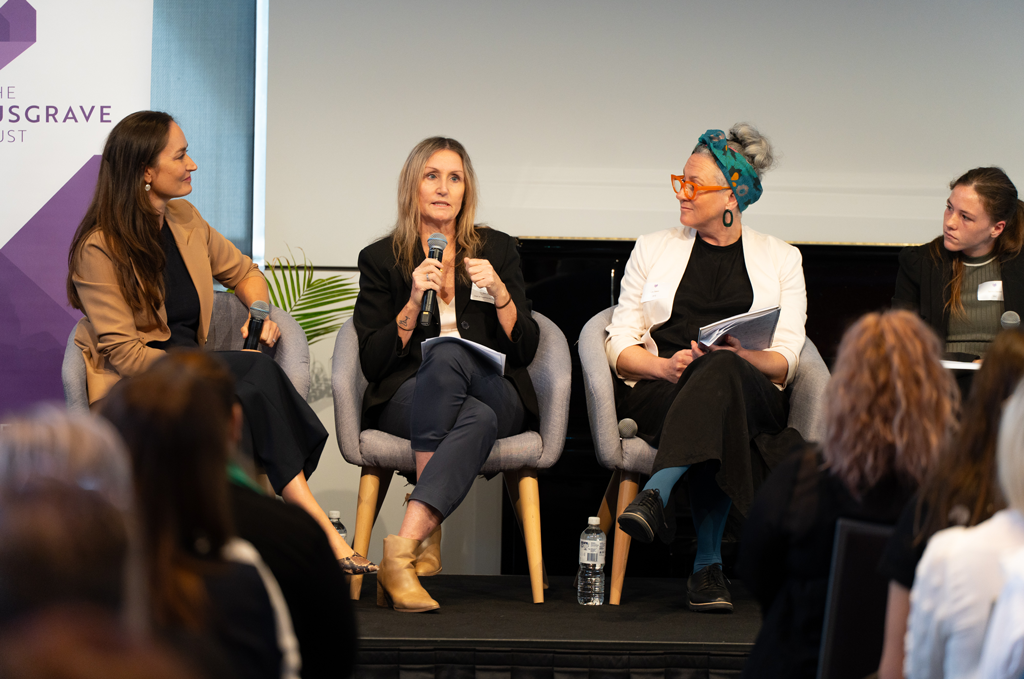
The Forum’s second panel, The Transformative Power of Home, examined why secure, affordable housing is foundational to growth and opportunity and how we can adapt our housing models to better support families and young people. This panel was facilitated by Lou Baker, senior manager of family and parenting programs at Brisbane Youth Service, and brought together Tamika Bennett, Youth Advocate at Youth Advocacy Centre (YAC); Kim McAlonan, Area Manager with Cairns Housing Service Centre; Laura Mahoney, Acting CEO of Launch Housing; and Victoria Parker, CEO of The Lady Musgrave Trust.
Here are the facts, straight from the frontlines.
Home remedy
Lou set the scene for this panel with an anecdote from her work at Brisbane Youth Service, which supports families and young people under the age of 25.
“We worked with one young family to transition from homelessness into motel accommodation,” she told the room. “Unfortunately, motel rooms are really difficult places to live – no yard, kitchen, bathroom or laundry.”
The couple and their children attended every parenting group session Brisbane Youth Service held – partly to escape the cramped confines of the motel room: “So we really began to understand their situation, their interpersonal dynamics and their struggle – and at times, it felt impossible.”
For a year, the family endured the motel room as they inched closer to accessing a community housing property. When the day arrived, Lou described how the three-year-old child ran through the house’s multiple rooms and asked if it was all theirs.
“That night, the kids had their first bath. And the parents wept.”
When the family returned the next week to the parenting session, it was night and day – in the best way.
“Everything shifted,” Lou said. “The kids were happy, regulated and engaged. The mum is now studying, the dad’s working. Everyone gets along.”
“It really showed us the difference that simply living in a different environment made for this family. They’ve still got their struggles, but it’s much closer to the normal experience of raising children.”
This is the transformative power of home. Housing is a human right. Deprived of this basic right, we cannot thrive or break the cycles of disadvantage that gouge deeper with repetition. With it, anything is possible.
“If you’ve never lived without a home, you won’t understand”
While Lou’s story showed the difference a home can make, Tamika’s story revealed how hard it can be to get there in the first place.
Tamika was a year old when her mother passed away and her father became a single parent. In the wake of her death, Tamika’s father fell behind on rent and developed substance abuse issues.
“That’s when we experienced our first bout of homelessness,” Tamika told the panel. “From the age of two til the age of 15, I was living in other people’s sheds infested with bats or under their houses, wiping away maggots that dropped through the floorboards.”
Her story echoes that of countless young people without a safe place to call home. The conventional image of homelessness is rough sleeping, but couch surfing (temporarily living with other people) is the more common and insidious evocation.
These transient arrangements are not safe or stable, and a leaky roof over your head isn’t a home. “There were periods when we were completely homeless and there were periods when we were homeless within someone else’s home.”
Tamika’s environment was a powerful anchor: despite moving constantly, she remained in the same suburb she grew up in. “I had the same school, the same family, the same friends. That gave me stability.”
Unbelievably, Tamika’s living situation flew under the radar. The primary school that was so comfortingly familiar failed to recognise a student in crisis.
“There was no offer of help or support. My school saw my address change monthly – at no point did they identify that a young person with their father is struggling, and they need help with housing. If someone had intervened then, my life would be completely different.”
When she reached her teenage years, Tamika linked in with youth services. For a time, her options were limited – under-16s are ineligible for youth housing, and a rocky relationship with Child Safety vetoed an alternative. Eventually, she accessed youth housing with the help of a youth worker.
“The turning point was finding someone who could navigate those services for me,” she says. “I had someone who understood the systems, who could tell me where to go to receive help and meet those basic needs – food, housing, laundry.”
Tamika was in survival mode, living from day to day. Crucially, her youth worker provided perspective as well as material support.
“I had someone who could see the bigger picture, who could see the breakdown of my life and access the services I needed,” she continued.
“Navigating the system feels impossible when your phone’s not charged, when you don’t know where you’re showering that night. You need to meet all these criteria to access housing. How can you meet their needs when you’re struggling to meet your basic needs?”
And the biggest help? “When I was rejected, I had someone who could pull me back up – because you can’t do it yourself when you’re in that state.”
There was a lot of rejection. Tamika called a service every week for two years. Finally, she was offered a year of transitional housing – in the “strange, unfamiliar” suburb of Lutwyche, far from the suburb that was the only constant in her life. She had 24 hours to accept the offer or go back to where she started, at the bottom of a two-year waitlist.
“Everyone in my life pushed me to say yes,” she told the panel. “They said, ‘although this is uncomfortable, although you have to make all these changes and then lose all your supports, this is the best thing for you to do, and you need to do it.’ And if they hadn’t pushed me to accept that house, I’d still be where I was.”
For a year and three months, Tamika had a place to call home – a model tenant, she was offered an additional three months. “I walked in and went, wow, the roof is sealed! That house was the stability I needed. I could go in and lock the door and feel safe.”
But temporary housing is a temporary solution. When Tamika’s time was up, she transitioned back to another unstable living situation. It was a difficult readjustment period. In a way, it felt like going back to the start.
“We need permanent housing options rather than just transitional options. With the time and effort it took for me to access housing so I could sustain a tenancy and get a tenancy record, to then return to the same environment … It was quite a struggle.”
Kim agreed, pointing out that crisis housing, transitional housing and long-term housing options are typically split between different programs and different locations. This means people may end up moving to “four or five different properties. And there’s no stability in that.”
Her team in Cairns has discussed the issue with service providers. Eventually, they hope to organise an innovative housing model locally. It would allow tenants to stay in the same house as the program transitions from crisis to transitional through to long-term.
“This is what our housing model should look like,” emphasised Tamika. “Move the program to another house, not the people.”
Snapshot of the solution
For Tamika and her father, an early intervention could have made a big difference. Her story isn’t uncommon – but it’s one that Kim has seen change at Cairns Housing Service Centre.
“Many of our young people inherited generational disadvantages: No housing skills, no tenancy skills and limited family support,” Kim said. “Often they’re victims of domestic and family violence.”
Her team found that access to housing on its own wasn’t enough to solve these complex issues. Their young people required wraparound support that addressed the underlying causes of homelessness. Many customers are First Nations and needed a culturally specific response.
“We developed a pilot program called the Young Parent Coordinated Care Program that provides young parents and expectant parents with housing and support in one package,” Kim explained. “It’s been an amazing success story.”
The program has taken over 50 referrals since the start of 2022 and has an astonishing 95% success rate. It has proven that its integrative approach works, but funding remains a concern.
“Our team went above and beyond to ensure sharing of services,” said Kim. “Our passion drove great outcomes, from supporting families early to building strong relationships between local service providers and housing,” said Kim. “Thanks to this pilot, the department is funding a new supported housing model through local organisation Sustaining Tenancies for Young People.”
Lou echoed an appeal repeated throughout the Forum, calling for a systemic response and a funding reform. “Organisations need to be able to deliver what we know works.”
Within an underfunded sector, specialised programs struggle to survive without hefty government investment. This is where philanthropy plays a critical role.
“Philanthropy allows you to have a partner with a higher risk tolerance than the government,” Victoria said. “That makes it a catalyst for more innovative solutions – which you can then de-risk and provide to the government.”
Homelessness is not the responsibility of any one individual, organisation or government to solve. It is everyone’s responsibility to contribute to a solution: that is what makes philanthropy both valuable and necessary.
“The Lady Musgrave Trust is really lucky in what we’re able to provide. Because our funding comes from philanthropy, we can do things differently,” Victoria continued.
“This funding is hard to find, but it enables us to tackle all the little things that make a big difference to someone’s life. We couldn’t do the work we do without it.”
“Philanthropy plays an essential role in funding our pilot programs,” Laura agreed. Her work at Launch Housing Victoria includes a pioneering program for women and children called Viv’s Place. Like Mums and Bubs, its success comes in spite of the fight for funding – and in spite of their success, mainstream implementation is still a long way off.
“Across the country, these programs work. We just need to embed them within the system.”
Bringing it all together: How Jinndii Waijung transforms lives in Logan
Jinndii Waijung (“Mother’s Nest” in Yugambeh language) is the result of years of planning, fundraising and collaboration – and this March, it welcomed the first young families into their new homes in Logan.
This brand-new supportive housing model provides four secure, self-contained units, shared learning spaces and on-site support – all within a safe, nurturing community designed for women and children. The model combines purpose-built housing with high-quality wraparound support, including individualised case management from a professional support team.
The Lady Musgrave Trust delivers Jinndii Waijung with the support of the Queensland Government and in partnership with industry, community organisations and women with lived experience of homelessness and domestic violence.
With Jinndii Waijung now complete, The Lady Musgrave Trust will provide approximately 12,000 nights of safety each year for young mums and their children across an expanding property portfolio. It stands as proof of what’s possible when the right partners come together.
Many of its tenants share Tamika’s experience of homelessness. Now, they can begin to rebuild their lives. For these women and children, programs like Jinndii Waijung aren’t just a safe place to stay: they’re a stepping stone to a better future.
“One woman told us when she moved in that it would be the first night she slept in her own bed for more than two years,” Victoria said.
“It took years to get here – but we’re already seeing the impact that this model has had on communities in need.”
Family first

The wraparound support that distinguishes programs like Jinndii Waijung, Viv’s Place and Mums and Bubs is far from the norm. Laura believes the current housing system is fragmentary and unfriendly to families and children.
“It’s not designed for them. The same housing system has to serve children, families, single adults, couples and young people, but all these groups have different needs,” explained Laura.
For example, entry points to services – “the front door into the homelessness system” – can be a chaotic, scary environment for children. Families typically can’t access all the services and resources they need in a single visit, which means they may need to travel back and forth.
It doesn’t have to be this way, Laura stressed. “We have an opportunity to rethink the system and design a new one, from a child-first perspective.”
She shared some key insights from Launch Housing Victoria’s recently published insights paper. This paper draws on sector research to help housing programs and services embrace a family-first approach and improve outcomes for families and children.
These are the top recommendations:
- Link in with education systems. Launch Housing supports hundreds of families living in motels. It works closely with local schools to ensure that children reconnect with education quickly.
- Prioritise early prevention and breaking cycles of intergenerational disadvantage. Laura suggests training teachers in trauma-informed teaching and focusing on keeping children in school.
- Provide easy access to legal advice and financial counselling.
- Redesign frontline and crisis response to avoid re-traumatising children.
- Factor in flexibility for families. The narrow categories of support in our current housing system – crisis, transitional and long-term or permanent – do not support complex family dynamics, kinship care arrangements and family growth. Rigid housing rules can punish women and families by withdrawing support when they have children.
A home is more than a roof over your head. It’s the first rung on the ladder to stability, safety and opportunity. With the right supports in place, every person can climb the ladder – and every one of us can help them up.
Read next: