
At the 2025 Annual Forum on Women and Homelessness, the national housing crisis was top of mind. Australians are living through a period of soaring rents, worsening poverty and widening inequality – and frontline services are sounding the alarm.
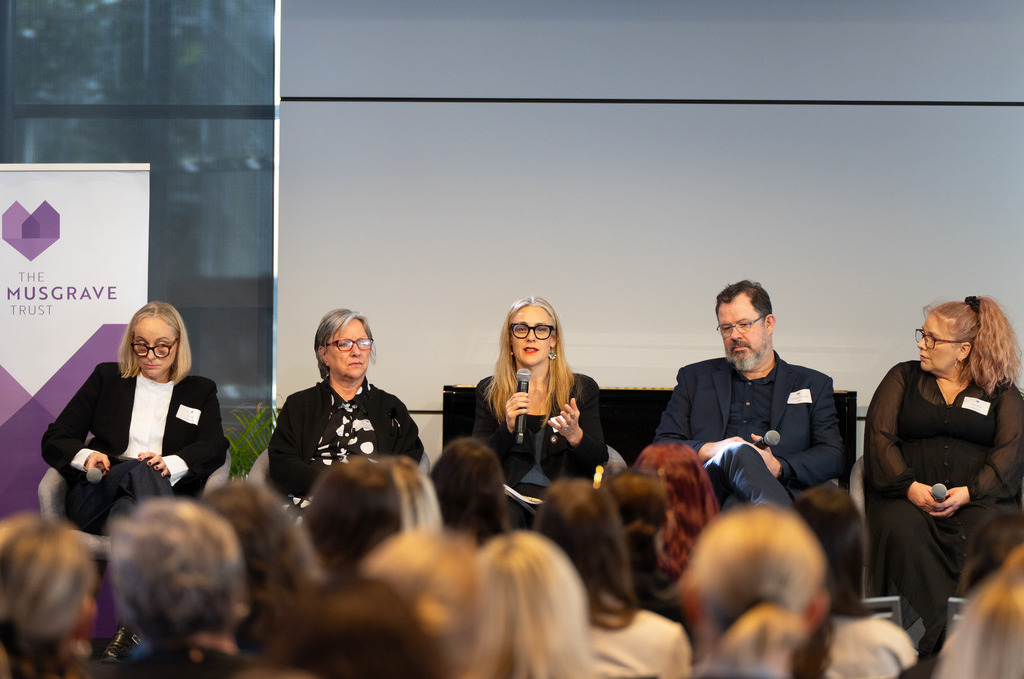
The Forum’s opening panel, All Ladders, No Snakes: The System, The Struggle, The Solution, brought together lived experience and sector leadership to explore how intergenerational disadvantage takes root – and how we can stop it in its tracks.
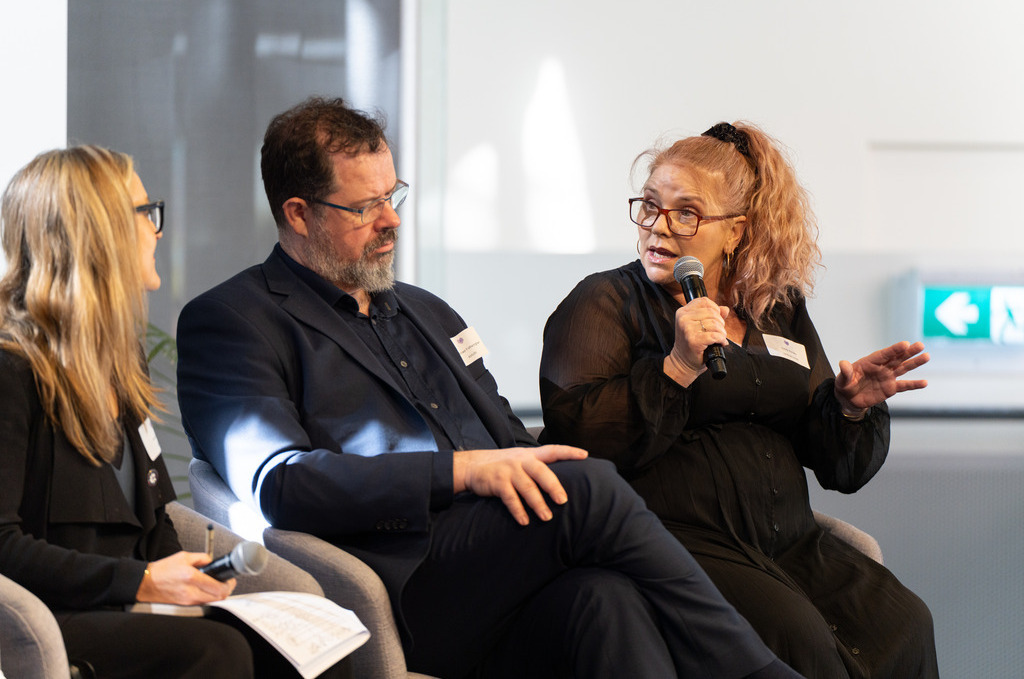
Facilitated by Aimee McVeigh, CEO of Queensland Council of Social Services (QCOSS), the panel included Cindy Barden, Founder of Lil Bug Love and lived experience advocate; Fiona Caniglia, CEO of QShelter; Dr Michael Fotheringham, Managing Director of the Australian Housing and Urban Research Institute (AHURI); and Sue Pope, CEO of Common Ground Queensland.
The panel unpacked the structural causes of poverty and housing insecurity, and called for coordinated, long-term solutions that move beyond band-aid responses.
Confronting structural disadvantage
In 2023, as the housing crisis deepened, the Federal Government began consulting on a proposed National Housing and Homelessness Plan – a long-awaited framework for reform. Two years later, it’s still in development.
At this year’s Forum, sector leaders called for urgency: not another patchwork of disconnected programs, but a collaborative, long-term strategy that addresses the structural roots of homelessness and poverty.
“In the last three years, we’ve heard repeated warnings that our systems are failing the people who need them most,” Aimee said. “Disadvantaged families do not have equal access to healthcare, education and housing, and their quality of life is suffering as a result.”
But it doesn’t have to be this way, she reminded the room. “These systems can further entrench people in disadvantage – or they can empower people to overcome the disadvantage they’re born into.”
“Unheard, unseen, unsafe”: Cindy’s story
Cindy Barden was raised to be tough as nails. Growing up, she was a keen student of martial arts. She carried her confidence with her – fearless, strong and self-assured.
“I thought I’d be the last person on the planet to end up in an abusive relationship,” Cindy told the panel. “And you know what? It happened, and it happened out of nowhere.”
After ending the relationship, Cindy and her young daughter were left without a safe place to live. For two months, they experienced homelessness, navigating temporary arrangements while facing ongoing threats and fear.
“I wish I’d known that there were resources I could call on,” she reflected. “I wish the police had known, because they were the only people I was speaking to.”
Domestic and family violence is the leading cause of homelessness in women and children. Police are often the first responders. With training, they can be an invaluable lifeline to support services – but all too often, women like Cindy are left in the dark.
“I didn’t know what services were available to me,” Cindy recalled. “It was chaos – I felt unheard, unseen, unsafe.”
Most of all, Cindy worried about the impact on her daughter.
“No kid should go through what my daughter went through. She was an incidental victim, but the trauma is real.”
Today, Cindy is an advocate for women and children affected by domestic and family violence. Through her initiative, Lil Bug Love, she delivers comfort kits to police stations and first responders. Her story highlights just how difficult it can be to navigate fragmented systems – and the importance of trauma-informed, wraparound support to help women to rebuild their lives.
Supportive housing that works
For families like Cindy’s, having a safe place to live is the foundation for everything else.
Sue Pope spoke about the Supportive Housing for Families (SH4F) Program, delivered in partnership with Micah Projects. The program leases private rental properties to families at a third of their income, with support available.
“We know that homelessness is traumatising, that it produces chronic health conditions and poor mental health,” Sue said. “These health disparities are occurring across generations, trapping families in disadvantage.”
Sue said that families enrolled in SH4F are enjoying peace and stability, sometimes for the first time.
“We’ve been delivering this program for four years. The vast majority of our families have been able to achieve a stable tenancy for more than 12 months – sometimes a lot more,” Sue explained. “We’ve seen these kids finish primary school, finish high school and work towards their own goals. This program has had really good outcomes for children in particular.”
Programs like SH4F can be a stepping stone to long-term housing and financial independence. Some families have been empowered to take over SH4F leases in their own names. But the necessity of these programs is an indictment of our private housing market.
This year, Queensland recorded its worst-ever rental affordability, with median-income households able to afford just 28% of available rentals. In a nationwide housing crisis, rent is ballooning out of all proportion – and low-income families are slipping through the cracks.
In response, the government has set ambitious goals to add more affordable housing to a depleted market. Dr Michael Fotheringham told the panel that tagging the housing crisis as a supply issue ignores other complex factors. Focussing on the quantity of homes can come at the cost of quality – the single dwellings proposed under the plan aren’t designed to accommodate families.
“We talk about supply, supply, supply,” said Michael. “But more housing won’t fix the lack of services that meet the needs of everyday families.”
A national plan – and the will to act
For real, lasting change, sector leaders agree that Australia needs a national strategy that goes beyond housing stock and tackles systemic inequality.
“We need to start investing more heavily in permanent housing responses and less heavily in transitional and crisis responses,” said Sue. “Because in this housing crisis, no one’s transitioning anywhere.”
“People are inheriting poverty at a structural level,” added Fiona Caniglia. “Our government needs to be brave enough to recalibrate how it funds services and responds to homelessness.”
Fiona referenced successful long-term poverty reduction frameworks in Canada and Ireland. This fully integrated approach demands coordination and commitment from every level of government. She believes that Australia can benefit from adopting a similar framework, but it will take all hands on deck.
Even with a national plan in place, Michael reminded the panel that there’s no easy solution – just a difficult climb for a fairer future.
“There is no silver bullet that will solve our housing crisis. We need to start doing a lot of things differently – and that requires a coordinated, national response.”