
As demand on housing services grows, so does the pressure to prove what’s working. But in a system built around people, not numbers, what does “success” really mean?
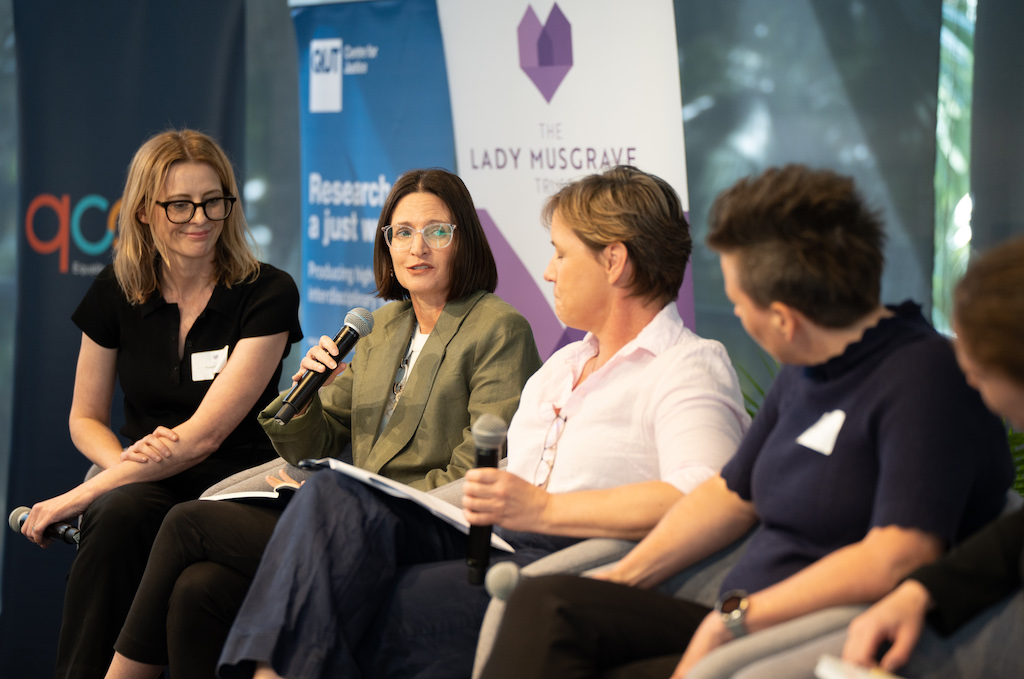
At the 2025 Lady Musgrave Trust Annual Forum on Women and Homelessness, the closing panel – ‘What’s the Size and Shape of Your Ladder?’ – brought together sector leaders to explore how data, evaluation and lived experience can work in harmony to drive change.
Facilitated by Julie Saunders, CEO of the Community Housing Industry Association Queensland, the discussion featured Tamika Bennett (Youth Advocacy Centre), Corin Moffatt (Foyer Foundation), Katie McDonald (YFS), Paulina Tapia (Brisbane Zero) and Rebecca Roberts (Deloitte Queensland).
Together, they unpacked what it means to measure progress without losing sight of people, and how combining data and humanity can create real impact.
Data with heart
Paulina Tapia, Coordinator of Brisbane Zero at Micah Projects, works with real-time data on homelessness in Queensland, including a large cohort of women with young families who are living in hotels. The phrase “data-driven approach” can sound clinical, but Paulina dispelled that misconception.
“Data is also about human experiences,” she said. “It helps make sense of what is happening in our community so we can advocate for change and make informed decisions.”
Corin Moffatt, Co-CEO of the Foyer Foundation, described herself as a “data nerd”, but one driven by empathy rather than abstraction. “I always look at what the data tells me about a problem first. Then I use the data to explain the problem, its solution and the impact we can have.”
She also acknowledged its limits: “There are always gaps in the data. We can look for outside-the-box solutions, but let’s be upfront about the inevitable challenges and limitations of data collection.”
For Katie McDonald, who leads evaluation and innovation at YFS, the goal is to keep humanity within the numbers. “When we measure outcomes, we try to keep that humanity in the data — the sense that our work is for and about real people.”
Measuring what matters
The conversation soon turned to how the sector can measure success in ways that reflect the realities of people’s lives. As Tamika Bennett from the Youth Advocacy Centre pointed out, those realities rarely fit neat reporting frameworks. “Everyone has different experiences and different needs,” she said. “Let [people in need] explain what success looks like to them, and let’s work together to achieve those goals.”
Katie agreed, saying evaluation only works when it reflects what people actually value. “Some people need supportive housing; others don’t. Listening to our clients and what they need from us is critical to using our resources efficiently and effectively.”
For Julie Saunders, CEO of CHIA Queensland and the panel facilitator, the challenge lies in capturing progress without reducing people to data points. “Ladders are linear,” she said. “They go up and down. But humans aren’t like that at all – we’re complex beings, and measuring human lives can be difficult and arbitrary.”
Corin echoed that sentiment, noting that despite the complexity, the outcomes people strive for are universal. “Everyone wants safe and stable housing and a job that helps them live with dignity,” she said. “They want connection and financial independence. Different services play different roles in helping people towards those universal goals.”
The business case for compassion
Rebecca Roberts, Lead Partner for Strategy and Business Design at Deloitte Queensland, recently completed an evaluation of Common Ground’s supportive housing model. She’s seen first-hand how innovative models can outperform traditional approaches, delivering better outcomes for individuals while saving government money in the long term.
“We need to make the financial and political incentives to fund these models really clear to the government,” Rebecca said. “So let’s explain the quantum of impact, the return on every dollar and the payback period.”
Corin echoed the sentiment that social change requires both compassion and calculation, and that successful pitches must speak the language of politicians and Treasury. “Some people make decisions based on emotions; other people make decisions based on facts and finance,” she said. “To tell your story of impact effectively to a diverse range of audiences, you need to bring both calculation and compassion to the table.
“I get quite frustrated at conversations with government officials who say, ‘Well, we can’t afford to put more into supported housing solutions. And I guess my answer is, ‘You can’t afford not to.’”
Learning in practice
In March 2025, The Lady Musgrave Trust and YFS celebrated the opening of Jinndii Waijung, a new housing project for young mothers and their children. The project embodies the panel’s message that meaningful change depends on evidence and empathy working together.
Katie explained that its design was informed by an evaluation framework built to measure what matters most to tenants – their stability, safety and sense of belonging – and the wellbeing of their family. “We engaged an evaluation and learning partner from the get-go, so we’re constantly learning and keeping people at the heart of what we’re doing.”
By combining rigorous evaluation with lived experience, Jinndii Waijung demonstrates how data can inform decisions without losing sight of humanity – turning the principles discussed at the Forum into practice.