
When disadvantage disrupts learning, education can feel out of reach. But across Queensland, schools and community hubs are redefining what support looks like, turning classrooms into safe spaces for recovery, connection and hope.
“We all know that education gives young people a ladder out of disadvantage and adversity. There’s also a large body of research telling us that traumatised and disadvantaged young people have a compromised ability to learn.”
This was how Dr Lyra L’Estrange, Senior Lecturer at QUT School of Education, described the double bind facing students, educators and service providers at The Lady Musgrave Trust 2025 Annual Forum on Women and Homelessness.
This year, the theme was “All Ladders, No Snakes.” Throughout the Forum, speakers returned to education as an essential rung on the ladder.
Lyra and her colleagues at QUT are leading the charge for an innovative, science-led approach to education that helps young people cope with trauma and engage in learning. This trauma-informed practice draws from bleeding edge research on the neurobiology of trauma and responses to adverse childhood experiences (ACEs).
Adverse experiences have outsize effects on children’s developing brains, rewiring neural pathways and altering brain chemistry. As a result, these children navigate additional barriers to learning.
The trauma-informed approach urges educators to reconsider why children present with poor behaviour in the classroom, and to understand behavioural issues as a set of symptoms – evidence of a struggling child who may need extra help. QUT is taking steps to integrate this approach into teaching programs within the Faculty of Creative Industries, Education and Social Justice.
“We need to design and implement education programs that support dysregulated young people and meet their complex needs,” Lyra told the third panel of the Annual Forum.
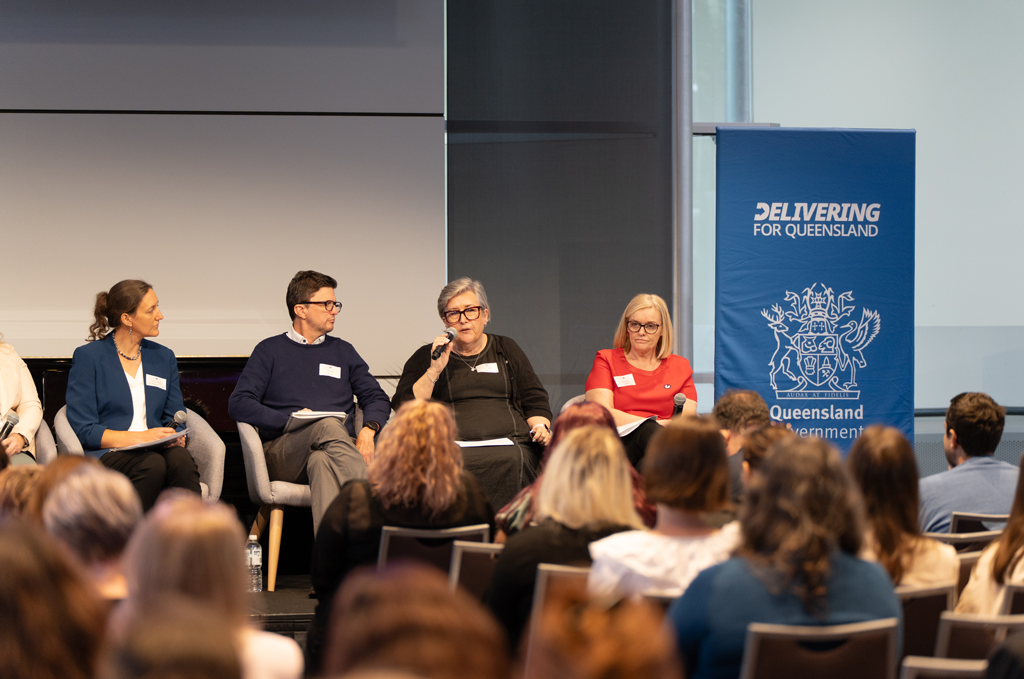
A Future Built on Hope: Education and Early Education heard from five sector workers who took up the challenge: Luke Baker, Manager, FamilyLinQ; Carolyn Curry, Wellspring Children and Families Hub Coordinator, Micah Projects; Corinne Harper, Young Families Connect (YFC) Program Manager, Ipswich State High School; Stephanie Blunt, Head of Wellbeing, Y Schools Queensland; and Caitlyn Wheatley, Youth Worker, Y Schools Queensland.
Facilitated by Dr Lyra L’Estrange, this panel explored four Queensland-based programs that use education as a tool to disrupt cycles of poverty and overcome disadvantage.
FamilyLinQ: “We’re pushing the boundaries of what’s possible”
Luke Baker is the Manager of FamilyLinQ, a recent hub-and-spoke initiative provided by the Bryan Foundation in partnership with the Department of Education.
“It’s a new approach that brings together education, health, family support, early childhood development programs, training and employment programs and community development – all within the school grounds,” Luke explained.
FamilyLinQ uses purpose-built buildings at Kingston State School and Corymbia State School. Its Kingston State School location includes a large lounge area, kitchen and play space, as well as training, meeting and consultation rooms for visiting health professionals.
The onsite location is key to FamilyLinQ’s success. It’s convenient for families and centres education as the site for intervention while reducing stress on schools. The ethos is “soft entry, early access.”
“Schools are important community platforms,” Luke said. “We tap into that to provide wraparound services, support, opportunities and activities for those families who are looking to engage – all in one setting.”
The hub model is a good start, but Luke believes we are far from the finish line. If anything, the single-setting model allows the real work to begin.
Housing services in the same brick-and-mortar location is easy, Luke told the panel. It is helpful. But it would be a glib panacea to our current crisis. A dentist’s office next door to an ophthalmologist is a convenience; it is not wraparound medical care made manifest. This is why social services must share more than a postcode.
We need to put programs in meaningful and productive conversation with one another. To do this, we will need solutions with more creativity, coordination and conceptual ambition than simply making them next-door neighbours.
“The hard part is integrating these fragmented and isolated systems so they work with each other, not just next to each other,” said Luke. “We’ve heard from a lot of speakers today about our siloed service systems. It’s clear that the mainstream approach is failing the families who need it most.”
FamilyLinQ is an alternative approach with mainstream backing, marking the first time a philanthropic organisation has partnered with the Queensland Department of Education. Given the Department’s 150-year history, that is a “pretty extraordinary” feat.
Luke hopes to grow FamilyLinQ’s wraparound model to more locations and communities around Queensland. The initiative is already seeing success at its two pilot locations. By building at scale, wraparound models like FamilyLinQ can become the rule, not the exception.
“Families are reaching out to services because they need support. They’re trying to engage, and they should not have to navigate these very difficult and complex systems in order to access help.”
Wellspring Children and Families Hub: “It’s about building trust and innovating”
Delivered by Micah Projects, the Wellspring Children and Families Hub offers specialised services including housing support, domestic and family violence support, healthcare, childcare, counselling, justice services and legal advice. Like FamilyLinQ, it embraces the wraparound, hub-and-spoke system model.
“The Hub provides a response for children and families experiencing adversity such as homelessness and domestic and family violence,” noted Carolyn Curry, Hub Coordinator.
Domestic and family violence is the leading cause of homelessness for women and children nationwide. For many families unable to afford housing or fleeing unstable living situations, motels have transformed into temporary crisis accommodation.
Micah Projects supports 278 families and 535 children living in motels, including 380 children aged five years and under. Among other services, the Wellspring Children and Families Hub runs a mobile outreach playgroup, taking playtime to the motels.
Carolyn is particularly proud of the Hub’s early years program.
“Within this program, we provide flexible-hours childcare three days a week in our purpose-designed space. But it’s also an early education program – we focus on preparing young children who aren’t enrolled in prep for the first year of primary school.”
The early years program combines Australia’s Belonging, Being and Becoming Early Years Learning Framework (EYLF) with insights from the Neurosequential Model of Therapeutics (NMT). Together, the two frameworks map out specific, appropriate and effective care for children with trauma.
The Early Years Learning Framework helps children feel comfortable and confident in their own identity, and engaged in the world around them. The Neurosequential Model is a set of strategies intended to regulate children who have experienced trauma. It works by calming the core brain functions that govern basic bodily responses before trying to engage the higher levels of the brain, which develop later.
“We’re always listening to the voice of lived experience, the voice of the child. Those early childhood experiences lay the foundation for what follows in a person’s life,” said Carolyn.
“If we want people to live to their fullest potential, these systems need to start valuing early childhood a lot more.”
Young Families Connect (YFC) Program: “It’s a great principle – and luckily, a great success”
Young Families Connect is based at Ipswich State High School and targets young mothers with the goal of re-engaging them in the education system.
Project Manager Corinne Harper recalled an earlier iteration of the program that focused on keeping expectant mothers enrolled in high school while navigating pregnancy. But as she watched formerly engaged students drift away after giving birth, it became apparent that the real challenge was ensuring that overwhelmed young mothers still received an education.
“Our communities don’t cater to teen mums looking for accommodation, for childcare, who want to live independently and not be separated from their children,” said Corinne. She wanted to design a program that would cater to the needs of young mothers, working with the education system to forestall any bumps in the road that might prevent a young mother from graduating.
Young Families Connect is the reply: a “one-stop shop” to meet students where they’re at. It provides free childcare, a child health clinic, domestic violence counselling and online flexible education. Its free online platform has enjoyed enthusiastic uptake post-COVID and is now firmly part of YFC’s DNA.
Someday soon, Corinne hopes to roll out the program statewide and expand it to serve young fathers as well.
“We’re always trying to stay current and adapt to students’ changing needs.”
Y Schools Queensland: “It’s so simple – why aren’t all schools doing this?”
The Y – formerly known as the YMCA – is the largest operation of the four, with 11 campuses delivering special assistance education across Queensland.
Stephanie Blunt, Head of Wellbeing at Y Schools, explained that each campus can provide the same opportunities as mainstream education, albeit with wraparound support to keep young people enrolled and learning. This year, there are nearly a thousand students enrolled in junior and senior national curriculum at Y Schools in Queensland, including pathways to QCE.
“For our young people, mainstream education was a round peg in a square hole – for various reasons, it just wasn’t the right fit,” said Stephanie. “At Y Schools, all of our young people are buddied up with youth workers for support both in and out of class.”
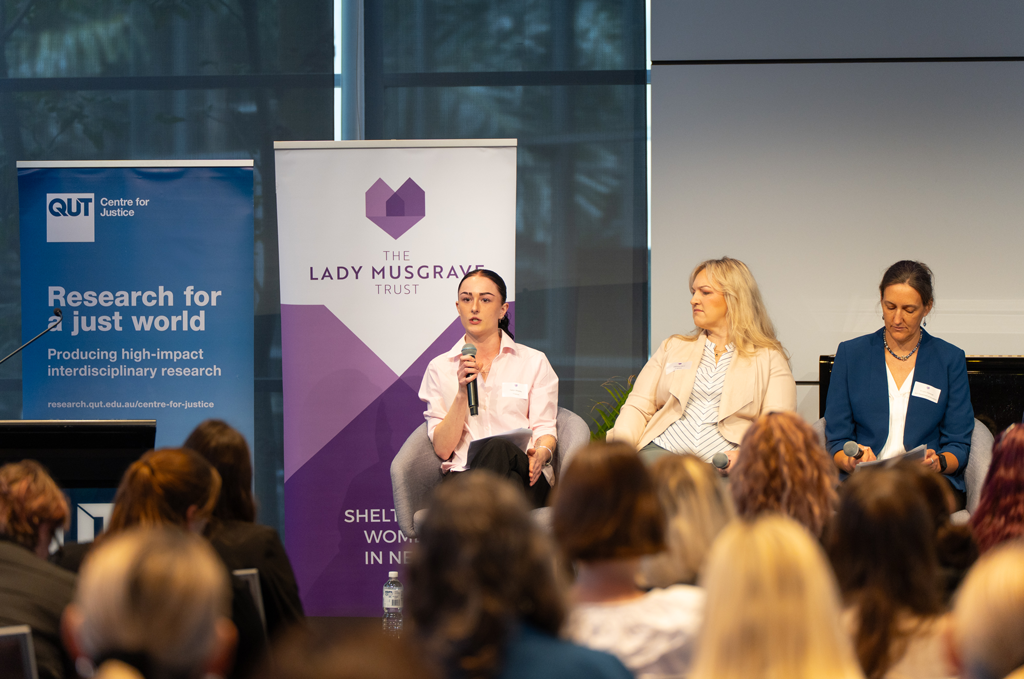
Caitlyn Wheatley recently joined Y Schools as a youth worker. She told the panel that it only takes one person, one service and one conversation to change the course of a young person’s life.
“My own lived experience has made me value services that find flexible ways for people to engage,” said Caitlyn. “Everyone deserves that opportunity, no matter their background or where they’ve come from.”
Caitlyn has already seen students benefit from practical solutions embedded in the flexible approach at Y Schools. These include:
- Individual learning plans tailored to the needs of each student.
- Adjusted timetables for young people with work or family responsibilities.
- Regular check-ins with an assigned youth worker.
- In-class learning adjustments for children with ADHD, anxiety, ASD and other diagnosed or undiagnosed barriers that force them out of mainstream education.
- “Chill passes” that give students a few minutes outside the classroom to self-regulate when they’re overwhelmed. Students might go for a walk, throw a basketball or visit a counselor.
- Headphones for students who work better with music or need to block out noise.
- Fidget toys to keep hands busy.
“I’ve met so many women and young people who, like me, are testimony to the fact that flexible approaches to education work,” emphasised Caitlyn.
The evidence is clear: Early, trauma-informed education can change the trajectory for women and children experiencing adversity.
Every young person in Queensland deserves a fair start. What’s needed now is the commitment to make programs like FamilyLinQ, Wellspring, Young Families Connect and Y Schools the standard, not the exception. We can ensure that trauma and disadvantage doesn’t define a child’s future – and that education becomes a ladder to success, not a barrier.